
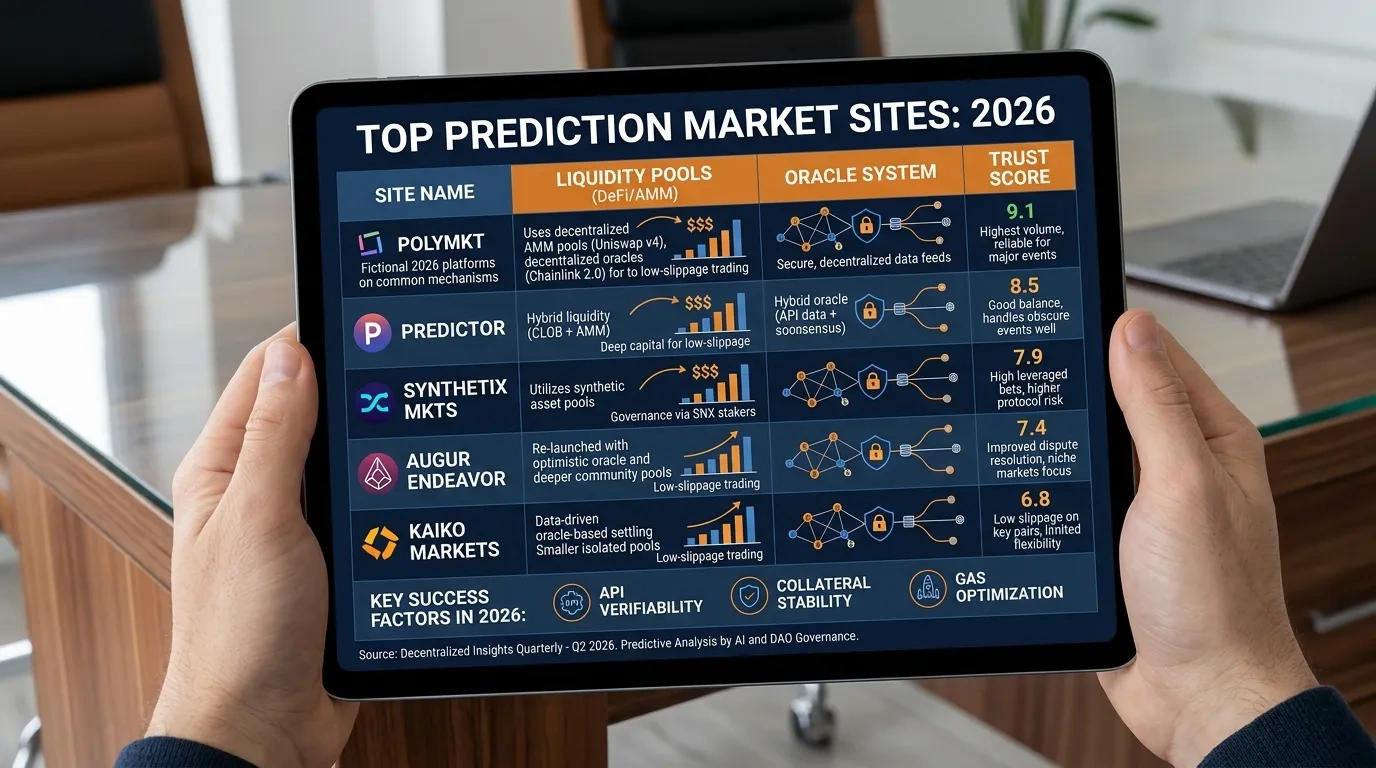
A liquidity-less prediction market is just a list of odds that you cannot trade. On these markets the spread will be wide enough to erase your edge. Closing your position then means you will have to spend hours waiting. Though such a market lists thousands of opportunities, the ones that actually matter are in the dozens.
The two systems that create the infrastructure of functional prediction markets are liquidity pools and resolution oracles. For a prediction market to be useful, liquidity pools create the ability to enter and exit a position fairly. An oracle determines whether you will be compensated for your correct prediction. Everything else above these systems, like the mobile app and market offerings, are of no real importance if either of the two are not present.
How Liquidity Pools Replace Order Books
Standard exchanges link buyers with sellers. If there is no one to supplement your trade, the trade does not go through. This problem is addressed by prediction market platforms, which eliminate order books and use automated market makers to facilitate trades. A smart contract contains reserves of outcome tokens for each event. This contract has a pricing function and modifies it after each trade.
The constant product rule
Most pools use the formula x * y = k. Here, x and y represent the number of tokens in each reserve. In this formula, k is a constant which means the product of the reserves is invariant. If a trader purchases YES tokens, the pool dispenses YES tokens from the YES reserve and collects NO tokens. The YES reserve is decreased, the NO reserve is increased, and the price moves.
Because of this system, every transaction adjusts the price. In deep pools, small transactions move the price a small amount. In shallow pools, large transactions move the price a lot. The thickness of the reserves decides how large a price movement is when a position is taken.
What capital providers actually do
To maintain a stable pricing curve, markets need deposits for all outcomes. Providers deposit outcome tokens into reserves and get LP shares. The protocol keeps track of each provider’s share. Upon withdrawal, providers get back their share and the earned swap fees.
The system is designed to have simple economics. Each transaction incurs a small fee, usually 1%. The more trades that occur, the higher the potential returns for providers. The main risk is if the market resolves in a way that is against the provider’s position. This risk creates an impermanent loss that can exceed the earned fees. Providers that deposit in markets that have a large trading volume with balanced trading on both sides can expect the highest returns with the least risk.
Prediction Market Sites – Trading Infrastructure in 2026
Daily trading volume across active platforms exceeds 100 million dollars. Total liquidity sits above 1.2 billion dollars. These numbers represent a market that has moved past the experimental phase into functional infrastructure. Five pool design approaches dominate the current landscape:
- Constant product AMM reserves – the standard formula that most venues use for binary outcome markets.
- Multi-outcome basket pools – capital backs every outcome in a single structure, enabling markets with three or more results.
- Hybrid AMM and order book layers – combining algorithmic pricing with traditional limit orders for professional traders.
- Curve models with tiered fees – adjusted fee structures that incentivise liquidity at specific price ranges.
- Concentrated liquidity near current pricing – providers deploy capital within narrow bands around the market price to reduce slippage.
The choice of pool design affects every trade. A constant product pool handles binary markets efficiently but struggles with multi-outcome events. A concentrated liquidity model reduces slippage near the current price but leaves gaps at the extremes. The platform’s pool architecture is not a background detail. It determines the cost of every position you open.
Slippage and order sizing
Order size determines how much a trade moves the price. A pool with deep reserves absorbs large orders with minimal price impact. A pool with shallow reserves moves significantly on even moderate volume. Splitting large orders across multiple transactions or routing through aggregators reduces the total slippage cost.
Market depth indicators show the reserve levels around the current price. Bid-ask spreads widen in thin pools. Cumulative depth at a few basis points from the midpoint reveals how much capital you can deploy before the price moves against you. Checking these metrics before entering a position is the equivalent of checking the odds before placing a bet.
Fragmentation across venues
Over thirty projects currently fragment capital across different pools and chains. A single event – an election, a sports outcome, a policy decision – might have markets on five different platforms with liquidity split between them. Aggregators scan pricing across venues and route orders to the pool offering the best execution. This fragmentation drives innovation in pool design but reduces the depth available at any single venue.
How Resolution Oracles Determine Payouts
The pool handles the trade. The oracle handles the outcome. When an event ends, the oracle records the result on the blockchain and triggers settlement. Without a functioning oracle, winning positions never convert to withdrawals.
The resolution process
After an event concludes, the oracle receives data from designated sources and submits the outcome to the smart contract. A challenge window opens – typically lasting between twenty-four and seventy-two hours. During this period, any participant can dispute the reported outcome by posting a counter-bond. If no dispute occurs, the outcome becomes final and winners receive their payouts.
Bond economics create the incentive structure. A proposer submitting an outcome must lock capital as a bond. If the proposal is correct, the bond returns with a reward. If it fails, the proposer loses the bond. This mechanism makes false reporting expensive and accurate reporting profitable.
Dispute layers
Disputes are ordered in levels of escalation. The first level allows for simple mistakes to be corrected fast. If the issue persists, it is brought to the community voting to evaluate the evidence. The highest level is final to a council of arbiters who review appeals. Each level of tier adds a cost to the verification which discourages trivial disputes while ensuring protection against legitimate mistakes.
Most major platforms operate with a dispute rate of below two percent. This usually is thanks to the well-defined contract specifications, which, at the time of market creation, clearly define metrics, time boundaries, data sources, and specify fallback rules. Markets that have well-defined terms have fewer disputes. Markets that lack clearly defined terms have more disputes.
Resolution speed and capital efficiency
Challenge windows determine how long funds stay locked after an event ends. Fast resolution returns capital within hours, allowing traders to redeploy into new contracts multiple times per month. Slow resolution keeps funds frozen for days or weeks. The trade-off is clear – speed unlocks capital faster but leaves less time to catch oracle errors before settlement becomes permanent.
What to Evaluate Before Choosing a Platform
The assessment criteria are not limited to the interface alone. There are four more determinants of how a platform can be used to deploy capital.
- First, pools are assessed market by market, not by the overall total value locked (TVL) of the platform. An advertisement of a platform having a TVL of one billion dollars means nothing if the market of interest has only ten thousand dollars in the reserves in that market. Always check market depth before opening a position.
- Next are the oracle stack and dispute history. A dispute rate of less than two percent indicates well-structured contracts. If the dispute rate is higher than five percent, then the contracts may have ambiguous terms and/or the data feeds may be unreliable. The optionality of the closure of the contract determines the speed of unlocking capital after the event is concluded.
- The cost incurred for the round trip due to the fee structure. A 0.5% swap fee means a cost of one percent for a round trip. This can be acceptable for a three-day hold, but on five trips for a week, this cost would be expensive.
- Lastly, the overall quality of the contract specifications matters. There must be exact specifications of terms, data feeds, thresholds, time bounds, and fallback rules to avoid and reduce the uncertainty of the outcome of the market.
The first determinant bears the most weight in practice when assessing a platform’s viability for executing trades. A market may have excellent oracles, low fees, and precise contract terms, but if the market has reserves that are not deep enough to absorb a trader’s position, then the market is, in practice, a failure.
Where the Infrastructure Goes From Here
The trajectory through 2026 points toward automation. Domain-specific resolution modules handle sports, finance and political outcomes with minimal human intervention. Automated judges built on language models can interpret contract terms and resolve data disputes without manual review. Tiered bond pricing adjusts collateral requirements to market size, making small markets viable without requiring disproportionate capital as security.
The prediction market infrastructure has matured past the point where the technology is the bottleneck. The bottleneck now is liquidity distribution – getting enough capital into enough markets to make the prices useful. The platforms that solve this distribution problem are the ones that will define the category through the rest of the decade.